



W3C Workshop, Call for Participation:
The Multilingual Web – The Way Ahead
15 - 16 March 2012, Luxembourg
Important dates
| 6 dec | Call for Participation issued |
|---|---|
| 10 feb | Deadline for speaker proposals |
| 17 feb | Acceptance notification sent |
| 20 feb | Program released |
| 2 Mar | Sponsorship deadline |
| 5 Mar | Registration deadline |
| 15-16 Mar | Workshop |
Endorsed by


Project funding
The MultilingualWeb project is funded by the European Commission through the ICT PSP Grant Agreement No. 250500, and as part of the Competitiveness and Innovation Framework Programme.
Today, the World Wide Web is fundamental to communication in all walks of life. As the share of English web pages decreases and that of other languages increases, it is vitally important to ensure the multilingual success of the World Wide Web.
The MultilingualWeb project is looking at best practices and standards related to all aspects of creating, localizing and deploying the Web multilingually. The project aims to raise the visibility of existing best practices and standards and identify gaps. The core vehicle for this is a series of four events which are planned for the coming two years. Following three highly successful events in Madrid, Pisa and Limerick, this fourth and final workshop will be held in Luxembourg and hosted by the Directorate-General for Translation (DGT) of the European Commission.
Important: We have been informed that in order to gain access to the Commission venue, you need to register by 5th March. Don't leave it too late.
On this page: How to participate • Goals, scope, audience • Venue, hotels, etc.
Related links: Registration • Program • About W3C
How to participate
Participation is free. We welcome participation from both speakers and non-speaking attendees.
If you are interested in attending, please register as soon as possible.
The total number of participants will be limited, and registrations will be dealt with on a first come, first served basis. Registration may close early if the event is full. W3C membership is not required to participate in this workshop.
If you wish to speak at the workshop, please fill in the registration form as soon as possible and provide a brief outline for your proposed talk at the appropriate place in that form. Based on a review of all submitted position papers, the Program Committee will select the most relevant and invite the submitters of those papers to speak at the event.
Presentations will typically last 15 minutes, however we may also have a small number of longer talks during the workshop. Your talk should describe standards and best practices relevant to the multilingual Web. Talks should ideally describe all of the following with relation to your topic:
- existing best practices and/or standards that are relevant
- new standards and best practices that are currently in development
- gaps that are not covered by best practices and/or standards
Speakers are asked to focus on describing practical ways in which the topic of their talk enables people to meet the challenges of the multilingual Web, rather than to focus on technical details. Given the diversity of topics at the workshop, speakers should also pitch their talk at a level that will be understood by attendees who are unfamiliar with the topic area.
We are particularly interested in innovative, unusual or first-time approaches to tackle known bottlenecks or gaps in the creation, localization and deployment of multilingal Web content and services.
If you have any questions, please contact This email address is being protected from spambots. You need JavaScript enabled to view it. .
Goals, Scope and Audience
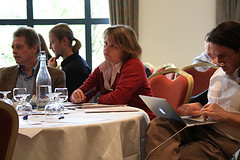
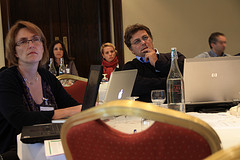
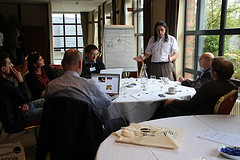
As with the previous events, the workshop will bring together speakers and participants with an interest in best practices and standards aimed at helping content creators, localizers, tools developers, and others meet the challenges of the multilingual Web. A unique proposition of the workshop is that it brings together speakers and provides opportunities for networking across a wide range of communities, to produce a holistic view of the problem.
The Open Space discussion forum was so successful in Limerick that we will be repeating the format in the Luxembourg workshop.
As before, we are looking for a wide spectrum of issues, ranging from blogs and social networking sites to localization of large corporate or organizational enterprises.
We are particularly interested in speakers who can identify gaps in standards and best practices related to the mutilingual Web, and propose opportunities for addressing those. With these workshops, the European Commission wishes to promote widespread adoption of novel, innovative solutions, workflows and approaches, and stimulate discussion on and concrete proposals for future EU-funded actions in the field of multilingual technologies.
Topics of interest include, but are not limited to, the following:
Developers. Browser support; Web addresses (IRIs and IDNs); Web protocols (HTTP(s), IRC, REST, etc); Content formats (HTML, CSS, SVG, etc); Scripting languages (JavaScript etc); Unicode; Local data formats (CLDR,etc); Language & locale tags; Data feeds ...
Creators. Content management and authoring tools; Browser support; Mobile Web; Voice on the Web; Language selection & navigation; Multilingual web sites; Usability & design for i18n ...
Localizers. Localization standards & tools; Optimizing localization processes, workflows and business models; TM and terminology databases; Machine translation; Crowd-sourcing; Cloud based issues; Process enablers ...
Users. Social Web (blogs, social media, etc.); Cultural topics; Minority languages; Accessibility; ...
Machines. Semantic web; Multilingual web services; Language resources; Text mining; Language technologies; Search engine optimization; Web architecture and processes ...
Policy makers. Why the multilingual web matters; Trends; Standards organization players; Political enforcements ...
Become a sponsor
W3C proposes a dedicated sponsorship program for these workshops to enable organizations to showcase their business and underscore their commitment to the shared goals of the W3C. The sponsorship benefits allow workshop sponsors to reach out to all stakeholders and decision makers worldwide and to be associated with breakthrough innovations that are paving the future of the Web.
Get more information about becoming a workshop sponsor. The deadline for sponsorship submissions for the Luxembourg workshop is 2 March 2012.
Venue, hotels, and other workshop logistics
Important dates
See the top of this page.
Workshop Venue
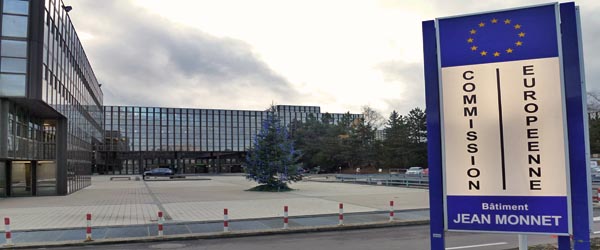
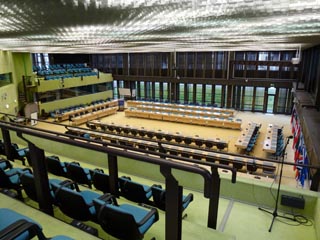
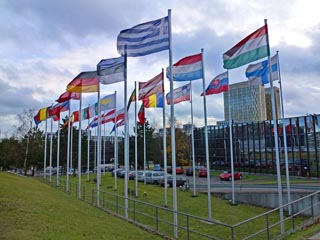
The workshop will be held at the Conference Centre of the Jean Monnet Building, at the following address:
European Commission
Jean Monnet Building
rue Albert Wehrer
L-2920 Luxembourg
NOTE: Participants must pre-register to access the building.
Lunch will be self-catering in the staff canteen of the conference center.
Getting there
How to reach the Jean Monnet building
FROM FINDEL AIRPORT
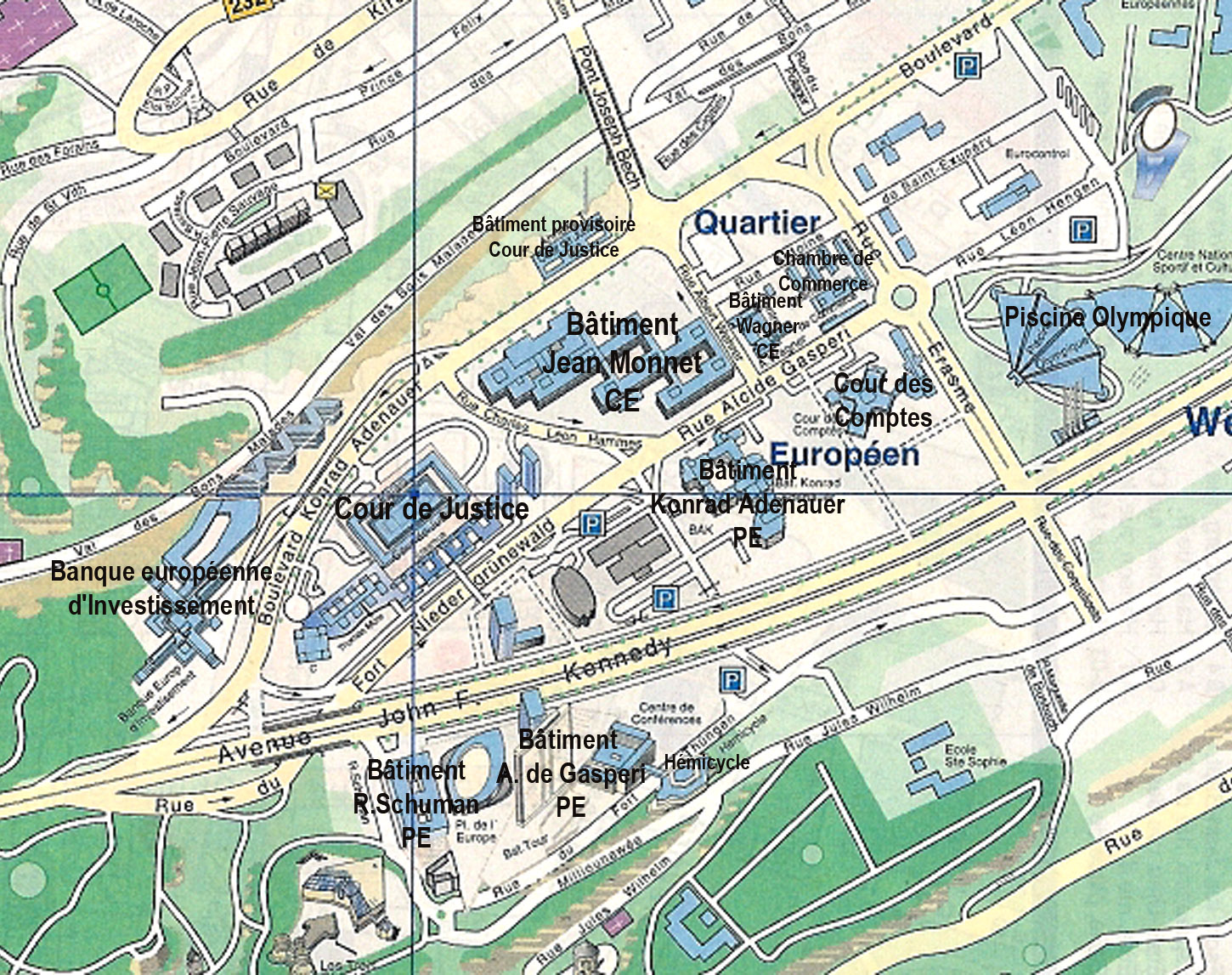
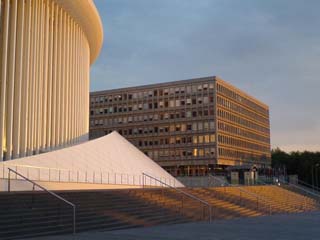
- Findel Airport. From there, ca. 10 minutes by taxi. Public transport: city bus n° 16 to bus stop "Philharmonie/MUDAM". You then have to walk for about 10 minutes to the Jean Monnet Building.
FROM CENTRAL STATION
- About 15 minutes by taxi or city bus n° 18 (direction "Kirchberg") to bus stop "Jean Monnet", close to the Jean Monnet Building.
By CAR
- The Jean Monnet Building is located in the north of Luxembourg city. On the motorway A1 Luxembourg-Trier (Treves), take exit "Kirchberg".
How to reach Luxembourg
By PLANE
By TRAIN
- From Paris - TGV
- From Koeln-Bonn
Other useful links
- Luxembourg City Tourist Office
- A Hotel Directory
- LUXAIR: the airline of Luxembourg
- CFL: Luxembourg Railways
- Bus routes and schedules
- Luxembourg, a European capital (PDF 676KB)
Hotel
There are no special deals with hotels. Just book with Booking.com or similar. The venue is in the Kirchberg quarter. A good rule of thumb is to reserve within walking distance of the blue line and take a bus to the venue. The bus service is good and runs according to a timetable.
From high to low:
- Walking distance from the venue: usually more expensive, except for Coque Hôtel, at the swimming pool (athlete rooms).
- Near the station, usually lower cost - direct bus.
- Youth Hostel
Warning: the Alvisse Parc Hotel and Hilton Hotel are not practical without a car: .
Contact
For assistance with workshop logistics or technical issues, you can write to Manuel Tomas Carrasco Benitez (manuel.carrasco-benitez at ec.europa.eu).
For questions about the program or the workshops in general, contact This email address is being protected from spambots. You need JavaScript enabled to view it. .
Deliverables
Workshop sessions and documents will be in English. After the event presentations, minutes and the workshop report will be made available to the public, linked from the project site.
Chair
- Richard Ishida, W3C
Local Organizer
- Manuel Tomas Carrasco Benitez, DGT
Program Committee
- Luis Bellido, Universidad Politécnica de Madrid, Spain
- Eric Blassin, Lionbridge Belgium
- Nicoletta Calzolari Zamorani, Consiglio Nazionale delle Ricerche, Italy
- Manuel Tomás Carrasco Benitez, European Commission, Directorate-General for Translation, Luxembourg
- Claudio Chiavetta, Lionbridge Belgium
- David Clarke, Transware Ltd (WeLocalize), Ireland
- Rahzeb Choudhury, TAUS, Netherlands
- Marko Grobelnik, Institut Jozef Stefan, Slovenia
- Ghassan Haddad, Facebook, USA
- Timo Honkela, Aalto-Korkeakoulusaatio, Finland
- Richard Ishida, W3C, UK
- Pål Eivind Jacobsen Nes, Opera Software, Norway
- Jiří Kosek, University of Economics, Prague, Czech Republic
- Christian Lieske, SAP AG, Germany
- Arle Lommel, LISA, Switzerland
- Andrea Marchetti, Consiglio Nazionale delle Ricerche, Italy
- Charles McCathieNevile, Opera Software, Norway
- Monica Monachini, Consiglio Nazionale delle Ricerche, Italy
- Jan Nelson, Microsoft Corporation, USA
- Chiara Pacella, Facebook Ireland
- Encarna Pastor, Universidad Politécnica de Madrid, Spain
- Spiridon Pilos, European Commission, Directorate-General for Translation, Luxembourg
- Adriane Rinsche, Language Technology Centre Ltd, UK
- Felix Sasaki, DFKI / University of appl. Sciences Potsdam, Germany
- Reinhard Schäler, The University of Limerick, Language Resource Centre, Ireland
- Dag Schmidtke, Microsoft Ireland
- Jörg Schütz, Bioloom Group, Germany
- Tadej Štajner, Institut Jozef Stefan, Slovenia
- Dan Tufis, Institutul de Cercetari Pentru Inteligenti Artificiala, Romania
- Cristina Valdés Rodríguez, University of Oviedo (ILTO), Spain
- Jaap van der Meer, TAUS, Netherlands
- Andrzej Zydroń, XML-INTL, UK
For more information, contact This email address is being protected from spambots. You need JavaScript enabled to view it. .

